Selected work · 2014–present
Boolean Lamp
Hand-blown glass pendants by ChiLab Design Studio
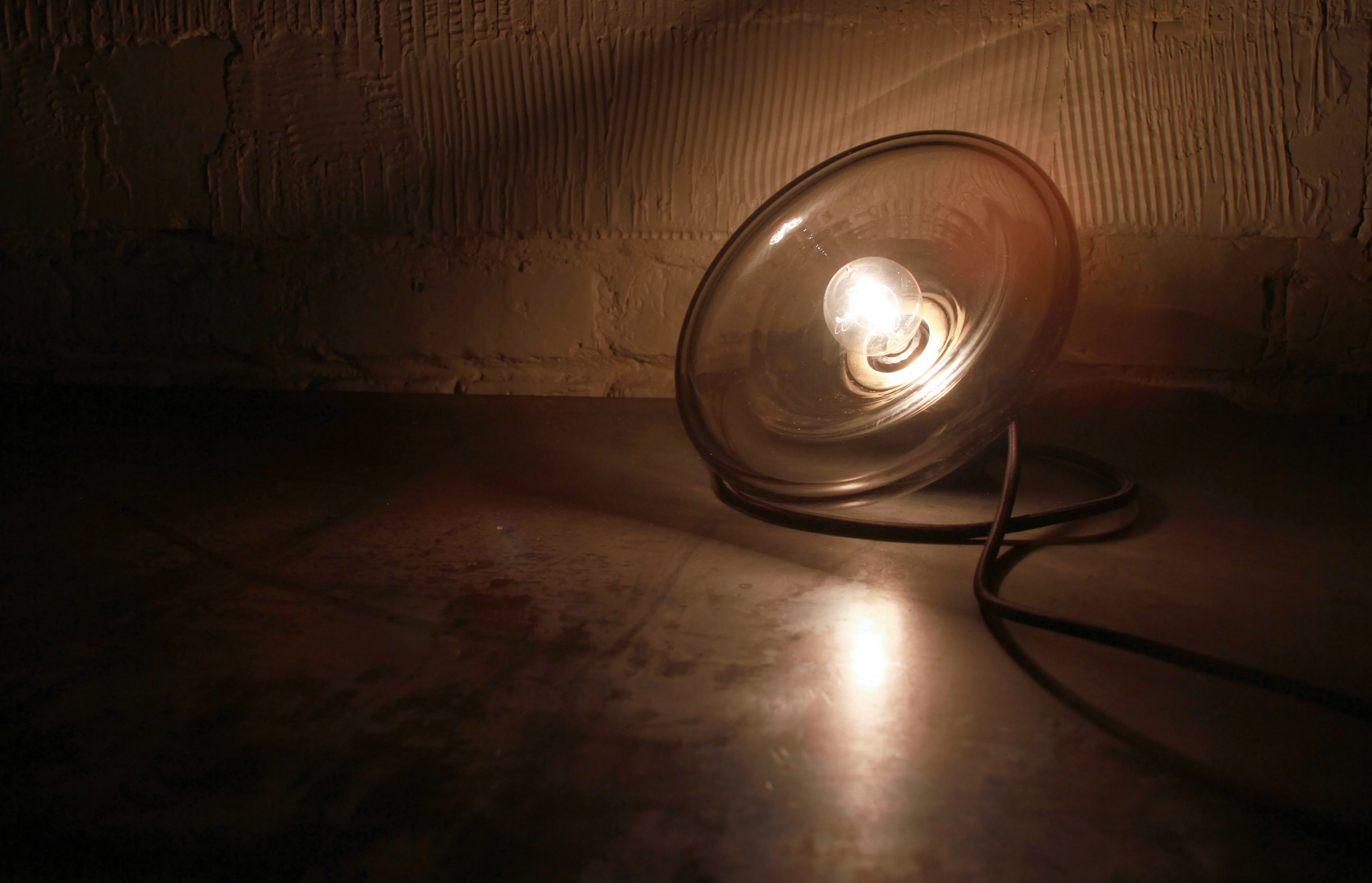
The Boolean Lamp takes an unremarkable object — the aluminum clip light, ubiquitous in studios and warehouses — and elevates it through hand-blown glass and considered base materials. Each piece is unique in the small variations of the glass while sharing a precise design language. The work is part of ChiLab Design Studio’s ongoing investigation into the everyday object as a site of careful redesign.
Computational design has, over the last few decades, appropriated the language of Boolean operations — union, intersection, difference — to describe what computers do to digital geometry. The terms now read as native to software. But the operations themselves are older. Pressing a soft material into a mold is a Boolean intersection. Cutting a void into a solid is a Boolean subtraction. Joining two volumes at a seam is a Boolean union. The vocabulary is computational; the techniques are not. The Boolean Lamp, designed at ChiLab Design Studio by Ben Stagl and me, performs a Boolean operation in glass. The technique was simple to describe and difficult to execute. We made a plaster form of a standard aluminum task light — one of the canonical industrial-design objects of the twentieth century — and then we blew a glass bubble and compressed the bubble around the form. The closing of the hot glass around the plaster object is the Boolean operation. What results is a glass lamp whose shape is the trace of an aluminum lamp — the same operation a CSG modeler would perform, executed with breath and heat instead of a mouse click
The lamp premiered at Wanted Design NYC in 2013, returned in 2014 to Wanted Design and to Tent London, and was awarded Best in Show at Wanted Design NYC in 2014. What the lamp argues, intellectually, is that the operations computational design claims as its own are older than the tools that name them. The dominant story about digital design and craft positions the two as opposed, or at best as complementary — the computer’s precision extending the hand’s intuition. The Boolean Lamp proposes a different relationship. The hand was performing Boolean operations long before the computer had a word for them. What computational vocabulary does, at its best, is help us see what craft has always done with new clarity. Glassblowing is, among other things, a fluid Boolean engine; the lamp is the first object we made that admits this directly.
Awarded Best in Show at Wanted Design NYC, 2014. Premiered alongside the Unfolding Chair at Tent London the same year, and exhibited at Wanted Design NYC in 2013, 2014, and 2016 (the 2016 iteration as part of the Outside the Box Chicago group exhibition with Ben Stagl).