Selected work · 2021–2022
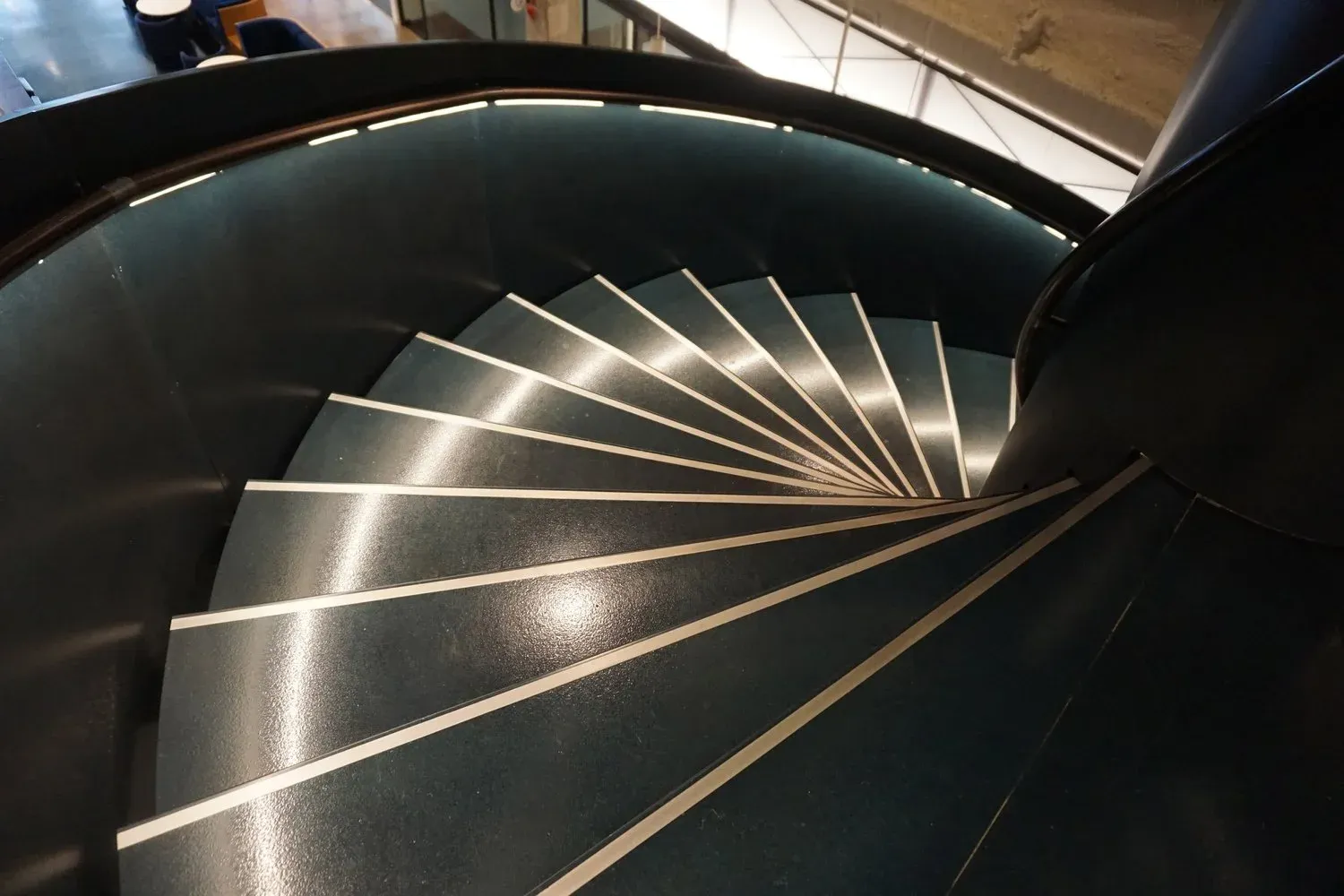
Grand Spiral Stair
Centerpiece staircase for Uber Freight at the Old Chicago Post Office
Old buildings ask hard questions of new design.
The Old Chicago Post Office was, for most of the twentieth century, one of the largest postal facilities in the country — a building whose interior logic was logistics, defined by the movement of paper. After the USPS vacated it in the 1990s [INFERRED — verify decade], the structure sat largely empty for decades before being redeveloped as a mixed-use commercial building. Uber Freight took its headquarters there. The historical irony is plain: a logistics building became a logistics company’s headquarters. The cargo changed; the argument did not.
The Grand Spiral Stair sits in the middle of that argument.
The stair was designed and fabricated through ChiLab Design Studio in collaboration with Gensler Chicago, who led the broader interior architecture for the headquarters build-out. With my ChiLab partner Ben Stagl, I led the digital design layer — the parametric modeling, the part geometry, and the fabrication documentation that translated design intent into something a shop could mill, weld, and patinate. The finished work is a sixteen-foot-diameter helix descending through the floor plate, finished in a custom blue-toned patina that reads as oil-rubbed bronze under most light, and crowned with an infinity mirror at its uppermost landing. The form references the building’s original mail chutes — the helical conduits that once carried letters between floors. The reference is not literal; the stair has to do the work of vertical circulation, not the work of sculpture. But the gesture is deliberate. The mail moved this way once. The people who move freight, now, move this way still.
The hard part of the work was the seam between the digital model and the historic shell. Old buildings are not square. The dimensional tolerances of an early-twentieth-century floor plate are not the tolerances of CNC-machined steel, and the gap between what the model assumes and what the site actually is has to be absorbed somewhere. We absorbed it in two places. The geometry was modularized and pre-assembled off-site so that on-site work was reduced to alignment rather than improvisation. And we designed a custom connection system that allowed for minute adjustment at every joint — a kind of dimensional give that let the precise digital object meet the imprecise physical one without either having to lie about the other. The patina was a digital question before it was a physical one: specifying a surface treatment that would read consistently across hundreds of components fabricated in different runs is a problem of color logic and material specification that begins in the model and has to survive the shop floor.
What the project is about, intellectually, is the relationship between digital design and historical continuity. The dominant story about computational fabrication is that it lets us produce work that could not previously be made — novel geometry, bespoke parts, unbuildable forms made buildable. That story is true. The more interesting story, to me, is that digital tools also let us hold a careful conversation with what already exists. They make it possible to insert new work into old buildings with a level of dimensional respect that earlier generations of fabrication could not afford. The Grand Spiral Stair could not have been built without 3D modeling, CNC, and the workflow that connects them. It also could not have been built without listening to the building it sits inside.
This work continues a longer practice with ChiLab, the design atelier I co-founded with Ben Stagl. Earlier ChiLab work — the Boolean Lamp, the Unfolding Chair — tested the same proposition at the scale of objects: that digital design tools, used carefully, can produce work with the warmth and specificity of craft. The stair is the largest application of that proposition we have made to date, and the first in which the work had to answer not just to its own internal logic but to the logic of a building older than any of us.